27th North Carolina Company D
"Tuckahoe Braves"
- Home
- About Us
- Events
- After Actions Reports
- FAQ
- Unit History
- 27th at Sharpsburg
- Current Roster
- Wartime Roster
- Uniform and Equipment
- Photo Gallery
- Bulletin Board
- Contact Us
- Related Links
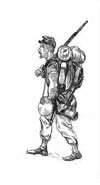
Uniform and Equipment Standards
The
following list
outlines the approved uniforms and equipment used by Company
D,
27th NCT. Since these items
are essential to our company-issued
North
Carolina
Troops impression, do not deviate from this list when making
uniform
and equipment
purchases. Check with our Uniform Committee for
a
list of
approved sources.
Please note that the below descriptions are meant to only give prospective members
a general idea of our requirements. For complete descriptions of the below items and
what is expected of new members, please contact the uniform committee.
Compiled by Abraham Wiles, Uniform Committee Member,
Company D 27th NCT
Bayonet:
Model appropriate for your rifle.
Bayonet Scabbard:
Black CS
scabbard with belt frog. All sewn construction.
No
rivets. Finial
tip.
Bed Sacks:
Bed sacks were akin to long pillowcases the length of a person. N.C. Confederate
soldiers stuffed them with straw, leaves, etc. to make field mattresses. In fact, the
U.S. Army still ordered them as late as WWI. They would be a welcome and comfortable
addition to our camp. Also, a bed sack lends itself to being used as a sleeping bag cover.
Blanket:
NC, Confederate or Federal
Canteen:
Confederate tin drum or Federal patterns.
Cap box:
Single loop
holder belt attachment. Black leather finish
with
no markings.
All sewn construction. NO
rivets!
Cartridge
Box:
Plain (no
CS, NC or maker's mark) black leather finish.
Both
leather and
stitching dyed. Sewn construction. NO
rivets!
Cartridge box belt:
Very
commonly found in the QM records. A must for
your
impression.
"Tarred" cloth strap with the double helix top
stitch.
Tent:
Members may
choose between either a common tent
(often
referred to as
an A tent by re-enactors) or a two-man shelter tent
(often
referred to as
a dog tent).
Drawers:
Cotton flannel under drawers.
Eyeglasses:
They need to be of a period design.
Groundcloth:
(Preferred) Canvas treated with a waterproofing, blacking compound.
Period
writings mention freshly made NC issued groundcloths drying
on
fence rails at
Salem,NC. The uniform committee
is
still developing a
source
for this item.
Other: Rubberized groundcloth
with Federal Makers
Marks.
Hat Cord:
A proper
blue infantry hat cord of either cotton or
worsted
wool is
acceptable for wear with the slouch hat.
Haversack:
Canvas with
half oval flap trimmed with twill tape.
Single
button
closure. Shoulder strap made from drill.
Body made from
duck.
Headgear:
Issued
Confederate cap (kepi). No "bummer" caps! Wool
or
gray jeans
material with simple black chin strap with no
buckle.
No hat
brass!
Privately
purchased slouch or "plug" hat. Black, gray
or
brown felt hat
with sweatband, taped brim and crown, rolled (turned
up)
edges.
Knapsack:
This is another widely documented item. It was as common to field
soldiers as shirts and shoes. 1. Issac and Campbell pattern, 2. CS :Kibbler"
pattern, 3. Federal "double-bag" can be used as a captured item only.
Lantern:
Although we
have used wooden lanterns in the past,
the
27th is moving away from
them. Since we do a field impression,
the
uniform
committee prefers that you purchase a tin lantern that could have
been
carried in the
knapsack.
Mess Gear:
Tin cup,
tin plate, spoon (period handle), knife
(period
handle and
shape) and fork (period handle with correct number of
tines).
NC Sack Coat:
Gray jeans with sewn down black epaulets. A N.C. sack coat is good to
have for
either the Tryon
Palace program or our three
annual
Fort
Macon
programs.
NC Depot Jacket:
Second
Pattern M1862 NC gray jeans depot jacket. Features
six
button,
rounded front, four-piece body, and one piece bellow
sleeves. No
trim.
Buttons may be either block or script infantry
I ,
N.C. sunburst;
or
period NC State seal. We do not use C.S. or C.S.A. buttons.
Overcoat:
Gray jeans
or wool.
Pipes:
Corncob
pipes are prohibited. Briarwood, meerschaum, or
clay
pipes are
among the most acceptable examples.
Those who
choose to smoke a briarwood pipe may choose
a
Peterson
two-piece pipe. One may also find nice briarwoods in the
Tinderbox
bargain bin if
the Peterson is too pricey. Those bargain box pipes
may
only have
small imperfections in the woods that prevent them from being
top
shelf
pipes. They are fine for what we
do.
Also, a
nice carved meerschaum is fine. The ball and
claw
or dog and
pheasant meerschaum patterns are among the most acceptable for
our
time
period. They are available at the
Tinderbox.
Finally, the venerable clay pipe is fit for use.
Pocket Watch:
The general
characteristics of a proper pocket watch for
the
time period
are:
Roman numerals instead of Arabic.
The case
should be plain and devoid of hunting
scenes,
trains,
etc.
The dials should be fairly plain
Key Wound
Watches are preferred. Although key wound
watches
are
preferable, stem wound pocket watches are more easily
obtained.
Rifle:
3 band P1853 Enfield (recommended model)
3 band M42 Springfields
3 band M1861 Springfields
Rifle Sling:
Either linen or leather
Shirt:
Cotton with
varying conservative designs. Gussets,
flat-feld
seams,
scalloped cuffs, padding and correct stitching is a
must.
Shoes:
Confederate, Federal, certain civilian
patterns, and English
imports are
acceptable. Our enlisted personnel do not wear
boots.
Skillet:
No cast iron. Steel body with an attached handle.
Socks:
We encourage our personnel to predominately wear cotton socks. Since
NC was a
major cotton producing state before and during the
war,
she made an
ample supply of cotton goods.
Suspenders:
Made of
cotton webbing, leather tabs, and steel or
brass
buckles.
Trousers:
Gray jeans
trousers with either french pockets (dog ear)
like
the Hightower
pattern or side seam pockets like the MacCrae pattern.
Our
trousers need
to have the back adjustment strap with buckle instead of
the
sometimes used
twine or leather cord. No stripes, vents, or flared cuffs.
We
don't portray
Brady Bunch extras or hillbillies.
Vest:
Civilian or military pattern.
Waist belt and buckle:
Black
leather of approved design with common roller
buckle.
No oval NC or
CS buckles.